Aug 122012
 

Catodo
2012
generative art project based on the architecture of the Aurum building
Result: 3 prints on forex 70×100 cm


The work of Catodo is a generative art project based on the architecture of the Aurum building in Pescara, the structure that will accomodate the Lampo exhibition on new frontiers of digital art.
The architecture of Aurum in Pescara has almost a circular shape that remember the structure of an amphitheater (Figure 1).
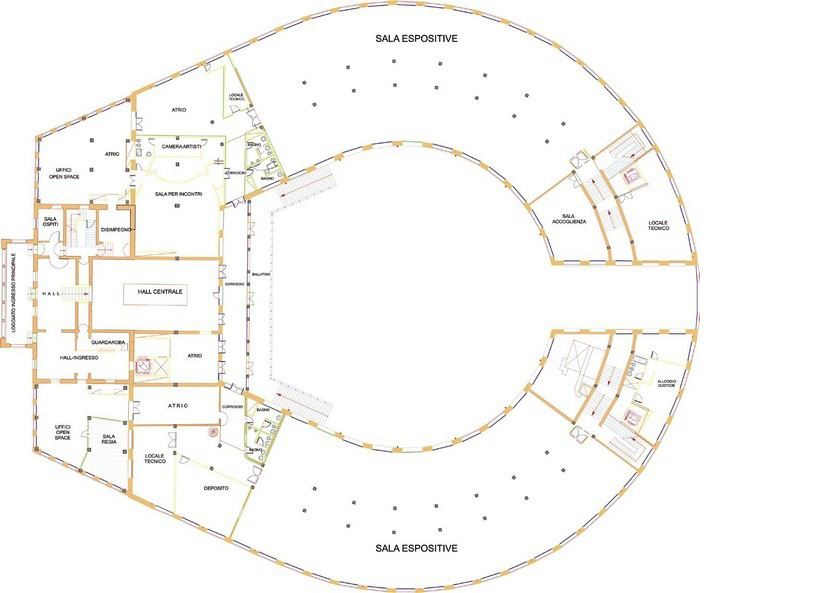
Figure 1 – Planimetry of the Aurum


Inspired by this shape, i built a computer algorithm that:
1. generates a variable number of points on a circle;
2. moves these points by a random value along the x and y axes;
3. joins these points using a spline based on the algorithm of Catmull-Rom.
A schema of this algorithm is reported in figure 2.
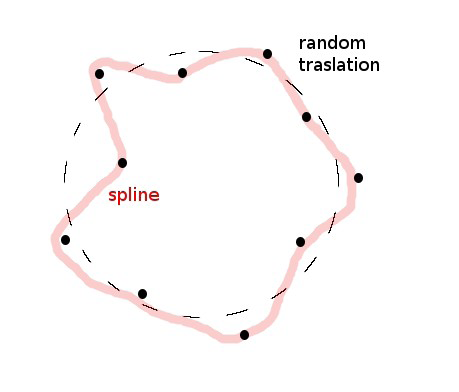
Figure 2 – Random points joined by a spline

The result of this algorithm has been used as pattern for the generation of the images. I used a random approach in the choise of the position, of the dimension of the radius, of the size of the lines, and for the value of the alpha color that has determined the opacity of the images.
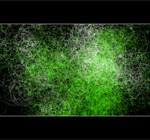
The management of the opacity has created an interesting effect of blurring that has produced a visual result similar to a complex system.
I experimented with three different predominant colors (green, red, and blue) and with a neutral color, white, generating three images in high resolution (100×70 cm) that represent the interconnection of two complex networks.
The generated images are represented by the Iteration #5132, #2149, #6534.


Technical Appendix
In this Appendix, I reported the source code of the algorithms that I used to generate the previous images.
Iteration_eng
Iteration

 Posted by at 11:08 am
Jun 142012
 

exhibition presented by the grey) (area . space for contemporary and media art – Korčula, Croatia
curated by Darko Fritz / grey) (area for Lampo Net & Contemporary art Exhibition, D’Annunzio Room, Aurum, Pescara

artists:
Darko Fritz (Croatia / Netherlands): 204 NO CONTENT
Hrvoje Hiršl (Croatia): Reversible (Le temps detruit tout)
jaromil (Italy / Netherlands): ASCII Shell Forkbomb
Ivan Marušić Klif (Croatia): Synchronicity
Luigi Pagliarini (Italy): RAS Robot Art Soccer
Edita Pecotić (Croatia / UK): Temporary Internet Files
Edita Pecotić (Croatia / UK): Temporary Internet Files2
Davor Sanvincenti (Croatia): 1 0 0 1 revisited
Thomson and Craighead (UK): The Time Machine in alphabetical order, video


about the grey) (area

 Posted by at 12:50 pm
Jun 142012
 

Luigi Pagliarini
[* Trans Adriatic Grey Area] 

“We have made a robot soccer model using LEGO Mindstorms robots, which was shown at RoboCup98 during the World Cup in soccer in France 1998. We developed the distributed behaviour-based approach in order to make a robust and high performing robot soccer demonstration. Indeed, our robots scored in an average of 75-80constructed a stadium out of LEGO pieces, including stadium light, rolling commercials, moving cameras projecting images to big screens, scoreboard and approximately 1500 small LEGO spectators who made the “Mexican wave” as known from soccer stadiums. These devices were controlled using the LEGO Dacta Control Lab system and the LEGO CodePilot system that allow programming motor reactions which can be based on sensor inputs. The wave of the LEGO spectators was made using the principle of emergent behaviour. There was no central control of the wave, but it emerges from the interaction between small units of spectators with a local feedback control.”

From: http://biblioteca.universia.net/html_bura/ficha/params/title/robot-soccer-with-lego-mindstorms/id/41662514.html

Video: matchday-LEGO1998

Photo: VOLKER STEGER/SCIENCE PHOTO LIBRARY

 Posted by at 10:42 am
Jun 142012
 

jaromil
2002 – 2012
digital prints
[* Trans Adriatic Grey Area] 


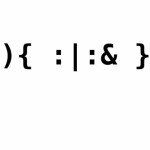
The code :(){ :|:& };: provides arguably one of the most elegant examples of a fork bomb.

It was presented as a free and open source piece of net:art in 2002, along with a text titled la bohème digitale.

Within the first 5 years of circulation, this net:art piece has propagated on computer screens, t-shirts and most impressively for its own author: tattoos.

Also featured on the geekytattoos website, among the pioneers carrying a logic bomb everywhere are SilveiraC0le and V.

This forkbomb is a kind of poetic virus. If its visually attractive line of only thirteen characters is entered into the command line of a Unix system and the enter key is pressed, within seconds the computer will crash because the devious little program commands it to make multiple copies of itself, setting off a chain reaction and thus quickly exhausting the system’s resources. Jaromil: “In considering a source code as literature, I am depicting viruses as poésie maudite, giambi against those selling the Net as a safe area for a bourgeois society. The relations, forces and laws governing the digital domain differ from those in the natural. The digital domain produces a form of chaos—sometimes uncomfortable because unusual, although fertile—to surf thru: in that chaos viruses are spontaneous compositions, lyrical in causing imperfections in machines made to serve and in representing the rebellion of our digital serfs.”

From the Wikipedia article Fork_bomb

In computing, the fork bomb, a form of denial-of-service attack against a computer system, implements the fork operation (or equivalent functionality) whereby a running process can create another running process. Fork bombs count as wabbits: they typically do not spread as worms or viruses. To incapacitate a system they rely on the assumption that the number of programs and processes which may execute simultaneously on a computer has a limit. A fork bomb works by creating a large number of processes very quickly in order to saturate the available space in the list of processes kept by the computer’s operating system. If the process table becomes saturated, no new programs may start until another process terminates. Even if that happens, it is not likely that a useful program may be started since the instances of the bomb program will each attempt to take any newly-available slot themselves. Not only do fork bombs use space in the process table: each child process uses further processor-time and memory. As a result of this, the system and existing programs slow down and become much more unresponsive and difficult or even impossible to use. As well as being specifically malicious, fork bombs can occur by accident in the normal development of software. The development of an application that listens on a network socket and acts as the server in a Client-server system may well use an infinite loop and fork operation in a manner similar to one of the programs presented below. A trivial bug in the source of this kind of application could cause a fork bomb during testing.

 Posted by at 1:35 am
Jun 142012
 

Davor Sanvincenti
2008 – 2012
physical audio-visual installation
[* Trans Adriatic Grey Area]


1 0 0 1 revisited is a study for trans-sensory organisms – activation of humans senses through defined audiovisual wave frequencies.

Bearing in mind a visitor’s “tired eye” saturated with millions of visual information, the installation insist on engaging the whole human body in perceiving the project. “1 0 0 1” employs light flashes and binaural beats to create the illusion, the moment when the observer finally gazes at 1838 photography by Louis Daguerre, titled “Boulevard du Temple”. The work reconstructs the possible “truthful” depiction of this freeze moment. The observer can discern black lines/blur in motion until the moment when it becomes obvious these are people, passers-by. The time has been turned back.

 Posted by at 1:18 am
Jun 142012
 

Edita Pecotić (Korčula / London)
– web project (on-line computer)
2011
[* Trans Adriatic Grey Area]


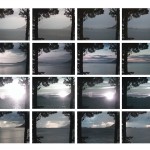
‘Temporary (Internet) Files 2’ is a series of time lapse videos that display seasonal transformations of a landscape. Each video last for 45 seconds and is made of a series of 100 still photos, collected via temporary internet files folder, from the online accessible webcam. The videos act as a form of meditation and contemplation on time and the corresponding notion of duration, as well as being a personal diary. By using contemporary technological resources, the work also makes a reference to the perception of time in modern culture. This work is continuation of previous ‘Temporary (Internet) Files’ project.

http://www.korculainfo.com/temporary/

 Posted by at 1:16 am
Jun 142012
 

Edita Pecotić
2007-2009
video color PAL, 4:3, 192′, silent
[* Trans Adriatic Grey Area]


‘Temporary (Internet) Files’ is a time lapse video which displays seasonal transformations of a landscape.  It is made of a series of still photos, collected over the course of a whole year, via ‘temporary internet files’ folder, from the public, online accessible webcam. The video acts as a form of meditation and contemplation on time and the corresponding notion of duration, as well as being a personal diary. By using contemporary technological resources, the work also makes a reference to the perception of time in modern culture. (www.editapecotic.com/temporary/)

“The whole of that time which I spent in the daily ritual of collecting, sorting and rearranging the photographic stills in a timeline, I experienced this process as a type of personal struggle against that inescapable disappearing. Surrendering to those moments where nothing happens, as the transitory is inevitable, I withdrew into a simultaneously sweet and bitter state of contemplation, filled with contented flow of time and the simultaneous interwoven sense of emptiness and helplessness of the moments which are all but gone forever.  In this way I followed, from day to day, one whole small world determinedly existing on the edge of fading, which awoke in me a feeling of abandonment into that middle space of reality, imagination and doubt. While the images of the town were lost in the dusk, time, enormous and unreachable, flew from every file, from every adjusted transition. In that careful, attentive following of change and the mute following of time, never knowing if it is about beginnings or endings and in my indecisiveness between documenting reality and running away from it, I tried to make something which is not just a visible window into a piece of reality, but a re-created history which is at the same time real and imagined” (Edita Pecotić)

The diary-like recording of the change between night and day, the weather motions and seasons in the everyday, gained for Edita Pecotić a base for creating a contemporary picture of a virtual reality. Using an additional reality and the compression of familiar images in a three-hour simulation of a new world, she has achieved an effectively geocentric reality where all is in continuous movement while the landscape remains still. There is a significant difference between the scenery in reality and that which the artist has created by organising gathered images into a timeline. Through selection and organisation; choosing details which she deemed significant, the artist has produced a shift from the real into the selective and subjective, thereby creating a process of shifting from the real to the unreal. Thus a familiar view becomes, in the words of Jean Baudillard, “fleeting and interesting electronic pictures elusive of reality”.  The ambient simulation of the landscape, created through compressing space and time is a process by which the artist attempts to problematise the space-time relationship and the human role in that relationship” (Zorica Beus, art critic).

 Posted by at 1:15 am
Jun 142012
 

Thomson and Craighead
2010, video
[* Trans Adriatic Grey Area]


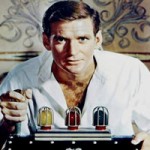
The Time Machine in alphabetical order is a complete rendition of the 1960’s film version of HG Wells Novella re-edited by us into alphabetical order from beginning to end. In doing so, we attempt to perform a kind of time travel on the movie’s original time line through the use of a system of classification.

Authors consider this experiment as using what they have decided to call ‘a constrained editing technique’ in light of the literary artistic movement Oulipo who would make works through the use of constrained writing techniques.

http://www.thomson-craighead.net/docs/thetimemachine.html

 Posted by at 1:14 am
Jun 142012
 

Ivan Marušić Klif
interactive DVD
[* Trans Adriatic Grey Area]


Synchronicity is a performance and an authorial DVD edition. A multichannel media performance separates a performer from his audience, while picture and sound get transferred from a confined scene space into an open space of auditorium. Author-performer uses simple light and audio devices, from time to time employing his own voice, partially live and partially reproduced, in order to gradually build happening of the image and the sound.

The performance is transmitted live into separated open space via 4 cameras and 4 microphones. Each camera and each microphone has its own screen and speakers system. Hence, image and sound transfer is happening with no additional processing, in 1:1 ratio. The performer has no feedback information as to what the audience hears and sees. Through combining light and sound sources, appearance and acoustics of the space is being continually changed and adapted. A small shift within inner space causes very big changes in the outer space. The performance is recorded full time.

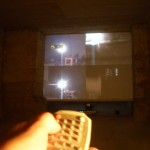
The second stage of project realization is a DVD edition. DVD medium enables setting of parallel channels of video, sound and text in an interactive modus. In this manner, a subject of synchronicity is again being referred to through another media. The same DVD is simultaneously a document of performance and an independent multimedia work. It is distributed as an artwork and project documentation at the same time. Thus authorised, the DVD renders an independent interactive work which is set within gallery space as a projection with Dolby surround sound system and remote control. The later enables visitors to combine and change channels of sound, video and text. Each of the few channels explains separate performance segment, for example, music and sound; author’s inner state; motivation; treatment of sound preparation, etc….


website Ivan Marušić Klif: http://boo.mi2.hr/~klif/

 Posted by at 1:11 am
Jun 142012
 

Hrvoje Hiršl
2012
video installation
[* Trans Adriatic Grey Area] 


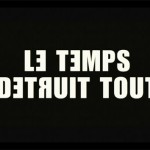
The cult film “Irreversible” of Gaspar Noé, is reedited and played backward in order to “correct” his originally twisted chronology and return it to the linear flow of time. This way, the movie ends with the “Happy Ending”. At the end of the film, that is, in this version, in the beginning, there is an inscription LE TEMPS DETRUIT TOUT (time destroys everything).


The second law of thermodynamics says that over the time things decay, namely, the order in a closed system reduces, ei, the entropy increases. Entropy is also called the arrow of time. Video projection is juxtaposed to the diagram that visualizes reversible and irreversible processes in thermodynamics. The diagram shows a hypothetical situation in which the process is reversible. The preconditions for this are that it is infinitely slow, and that there is no friction. All natural or spontaneous processes are irreversible. Given that this is the medium of film that is not a natural process, it is reversible, but in the process the narration is destroyed.


There is a famous Stephen Hawking’s statement in which he linked the “psychological time”, the way we remember things and “entropic time.” In other words, if the flow of entropy would reverse (as far as our brain is concerned) then literally time would go in the opposite direction, by which Hawking stated that the entropy and time are inextricably linked.

 Posted by at 1:08 am
Jun 142012
 

Darko Fritz (Croatia / Netherlands)
2007 – 2008
horticulture installation (prints, video at the monitor – if available, no sound)
[* Trans Adriatic Grey Area] 


The horticulture unit ‘204_NO_CONTENT’ is made of organic elements, transgressing the contents from the digital domain.

The textual context of the picture is a text found in the computer language that reads ‘204_NO_CONTENT’. It is an error report that appears in the internet communication. A machine communicates with another machine about protocols of failed communication [HTML server error], and thus providing the user with the insight into the problem. Error ‘204 No Content’ means that the server has fulfilled the request but there is no new information to send back.

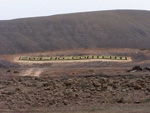
A typographical picture located in the desert is 3.6 x 31 meter in size and shaped within the matrix made of 18 x 166 fields [2988 ‘pixels’]. This ‘low-resolution screen’ is made of cactuses and black lava. The ‘active pixels’ are made of 2220 cactuses [Echinocactus grusonii]. At the beginning of the project each cactus was approximately 18 cm in diameter.

Materials used in the installation are chosen respecting natural resources and availability at the Fuerteventura island. Fuerteventura island is of volcanic origin and therefore black lava is widely available. The Echinocactus grusonii cactuses are visible around the island and have an status of the local souvenir at the local airport. The sent used within and around the installation is of local origin.

204_NO_CONTENT is part of the Internet Error Messages project by Darko Fritz [since 2001].

 Posted by at 1:05 am